Blog
Research notes, technical deep dives, and perspectives from the teams building expert AI for finance.
Highlighted Post
Introducing FrontierFinance: A Challenging Benchmark for Measuring Frontier Intelligence of Finance Agents
We release FrontierFinance, an open benchmark for measuring how well finance AI agents perform across the full investor workflow, from screening and discovery to modeling and catalyst monitoring. It contains 220 expert-crafted queries spanning six finance use cases, making it the largest open benchmark of its kind. Samaya's agent system scores 50.8% on the benchmark, outperforming the best frontier model at 4x lower cost.
Read Article →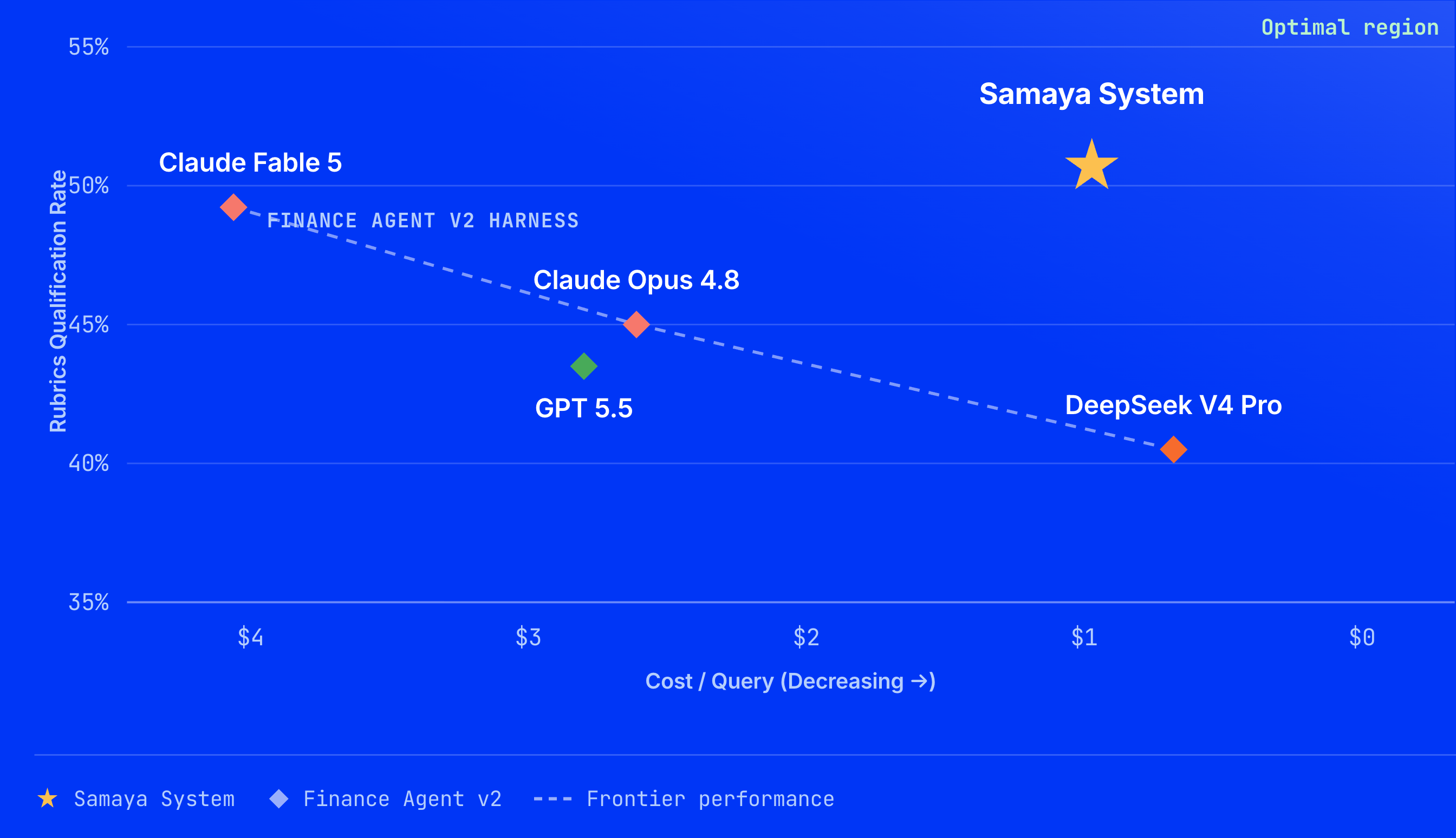
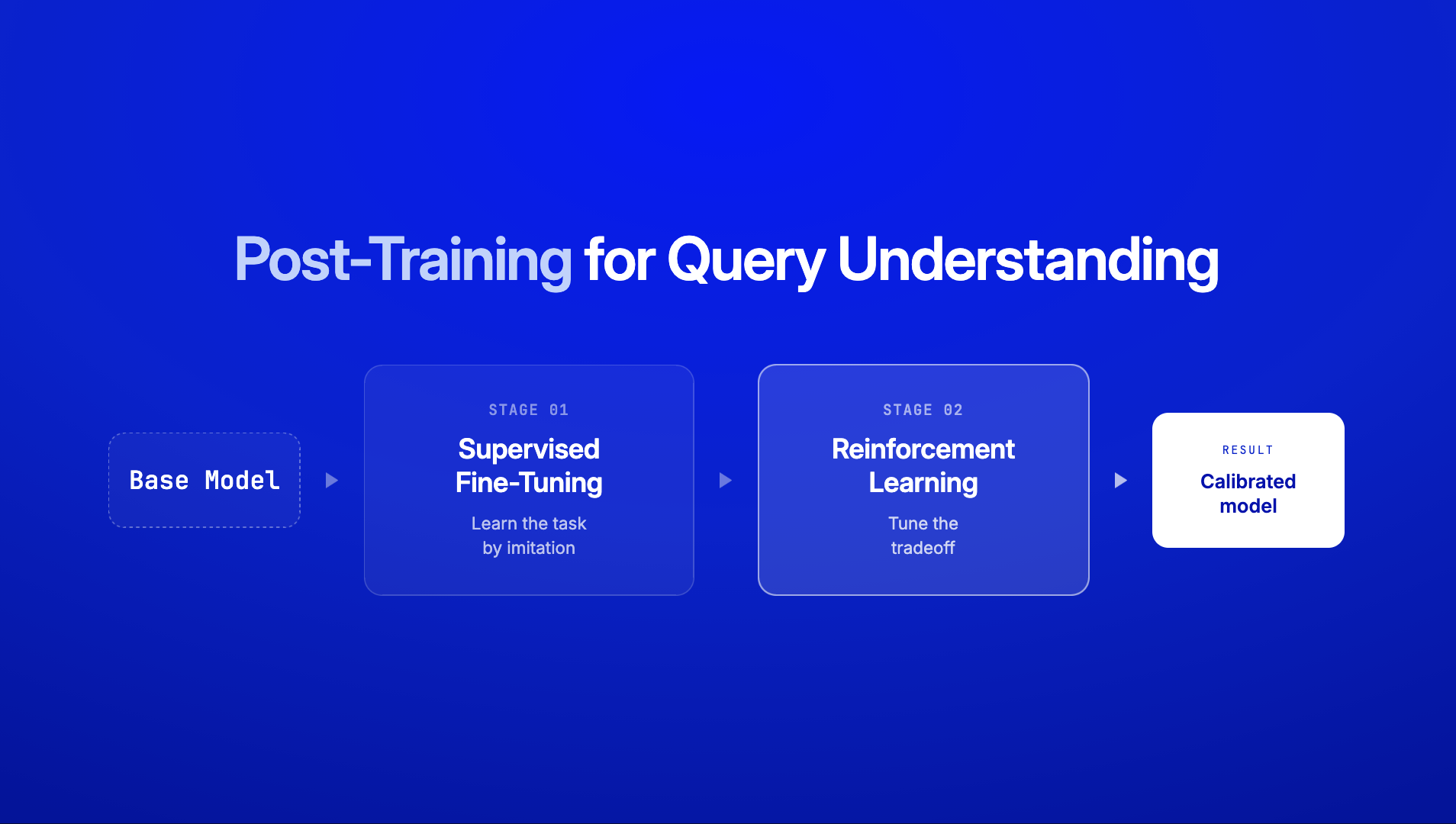
Before the Search: Why Query Understanding Matters for Financial Agents
AI agents have an Achilles' heel: query understanding. We explain why finance-specific query understanding is a hard and important problem, how we train models for it, and why improvements at this layer translate into better downstream performance.
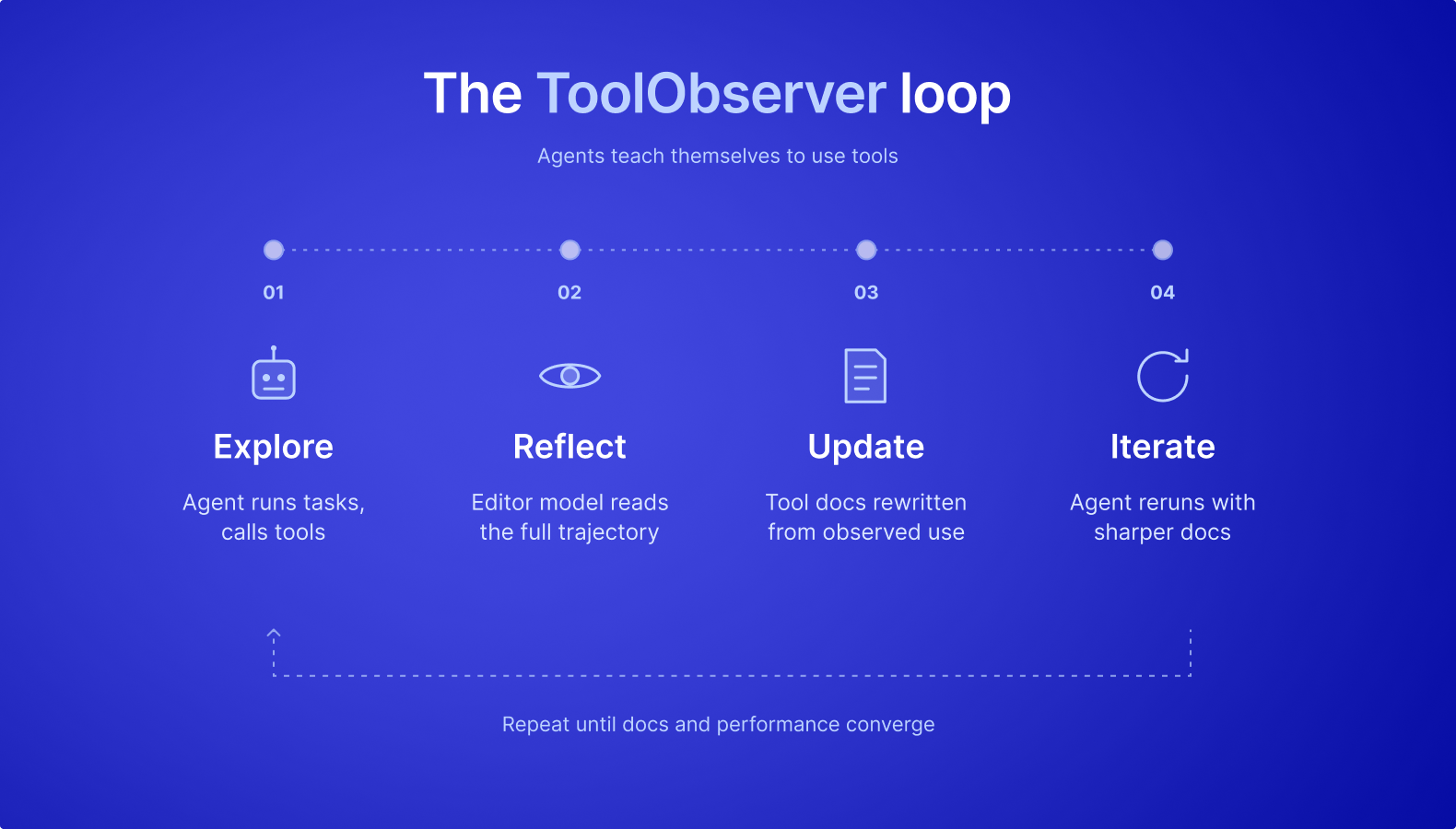
When Tool Documentation Falls Short: Teaching Agents to Learn From Interaction
Samaya AI's ToolObserver lets agents learn tool behavior from actual task trajectories instead of static docs. On the new OpaqueToolsBench, it beats state-of-the-art methods by 18.6% while using 3.5–7.5× fewer tokens.

Lost in the Maze: Overcoming Context Limitations in Long-Horizon Agentic Search
Samaya's researchers create deep research systems that outperform existing frameworks while using a fraction of the tool calls with a simple and effective method for context management.

Criteria-Eval: Evaluating Long-form Answers to Complex Questions
A checklist-based evaluation framework that directly aligns with how expert users judge quality of long-form LLM-generated answers.

Promptriever: Elevating Retrieval Models with Instruction-Following Capabilities
Can your retrieval model follow instructions like an LLM? We answer this via our latest research work.

Evaluation of AI Agents at Samaya
What makes one AI agent better than another? We are building evaluation environments to measure performance on realistic and ambitious scenarios.

Causal World Models: Bridging AI and Human Expertise
At Samaya, we are pushing the boundaries of reasoning systems by building causal world models that are designed to predict and explain economic outcomes resulting from unseen events.

The best AIs will be constructed, not emergent
As we approach two years since the launch of ChatGPT, and with the recent launch of o1, the AI ecosystem is evolving into its next phase. The early excitement of pure foundation model building is seeing consolidation, and there is simultaneously a frenzy of activity on new AI applications and new AI capabilities to support them.

Can machines assist humans in verifying world knowledge?
For millennia humans have been producing knowledge. The advent of computers helped turn this knowledge into a digital format, and the web made it widely accessible, boosting progress and further knowledge creation. Search engines have dramatically increased the breadth and accessibility of information that we can use in our everyday decision making, much beyond the limits of books and conventional libraries.

Information overload: the challenges of expanding context windows in large language models
Language models have demonstrated impressive performance for a variety of applications and use-cases, but limitations remain—for example, it is difficult to add knowledge beyond their pre-training knowledge cut-off, and they may generate factually incorrect statements. Overcoming these shortcomings requires incorporating external knowledge into language models.

Does one large model rule them all?
The past 10 years have seen a constant stream of AI advances, with each new wave of developments enabling exciting new capabilities and applications. The biggest such wave has undoubtedly been the recent rise of a single, general AI model, for example LLMs, which can be used for an enormous diversity of tasks, from code generation, to image understanding to scientific reasoning.